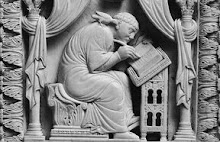
“Of the music of the universe, some is characteristic of the elements, some of the planets, some of the season: of the elements in their mass, number, and volume; of the planets in their situation, motion, and nature; of the season in days (in the alternation of day and night), in months (in the waxing and waning of the moons), and in years (in the succession of spring, summer, autumn, and winter).”
Hugh of St. Victor
Showing posts with label Music of the Spheres. Show all posts
Showing posts with label Music of the Spheres. Show all posts
Monday, December 21, 2009

Music and Harmonia
“For all that we might smile benignly at in the mathematical clumsiness and rhetorical hyperbole of the classical philosopher of music or in the intellectual abstractions and tetchy fussiness of the medieval theorist, is there not something in the notion of being ‘cradles’ in God’s created harmonia that is worth recovering?”
Jeremy Begbie, Resounding Truth: Christian Wisdom in the World of Music
Jeremy Begbie, Resounding Truth: Christian Wisdom in the World of Music
Monday, May 4, 2009
Song of Creation
This following is from Spurgeon's Cheque Book of the Bank of Faith from May 1:
The mountains and the hills shall break forth before you into singing, and all the trees of the field shall clap their hands. (Isaiah 55:12)
When sin is pardoned, our greatest sorrow is ended, and our truest pleasure begins. Such is the joy which the Lord bestows upon His reconciled ones, that it overflows and fills all nature with delight. The material world has latent music in it, and a renewed heart knows how to bring it out and make it vocal. Creation is the organ, and a gracious man finds out its keys, lays his hand thereon, and wakes the whole system of the universe to the harmony of praise. Mountains and hills, and other great objects, are, as it were, the bass of the chorus; while the trees of the wood, and all things that have life, take up the air of the melodious song.
When God's Word is made to prosper among us and souls are saved, then everything seems full of song. When we hear the confessions of young believers and the testimonies of well-instructed saints, we are made so happy that we must praise the Lord, and then it seems as if rocks and hills and woods and fields echo our joy-notes and turn the world into an orchestra. Lord, on this happy May Day, lead me out into thy tuneful world as rich in praise as a lark in full song.
The mountains and the hills shall break forth before you into singing, and all the trees of the field shall clap their hands. (Isaiah 55:12)
When sin is pardoned, our greatest sorrow is ended, and our truest pleasure begins. Such is the joy which the Lord bestows upon His reconciled ones, that it overflows and fills all nature with delight. The material world has latent music in it, and a renewed heart knows how to bring it out and make it vocal. Creation is the organ, and a gracious man finds out its keys, lays his hand thereon, and wakes the whole system of the universe to the harmony of praise. Mountains and hills, and other great objects, are, as it were, the bass of the chorus; while the trees of the wood, and all things that have life, take up the air of the melodious song.
When God's Word is made to prosper among us and souls are saved, then everything seems full of song. When we hear the confessions of young believers and the testimonies of well-instructed saints, we are made so happy that we must praise the Lord, and then it seems as if rocks and hills and woods and fields echo our joy-notes and turn the world into an orchestra. Lord, on this happy May Day, lead me out into thy tuneful world as rich in praise as a lark in full song.
Sunday, March 29, 2009
Cosmological Harmony
Cosmological harmony was actually one of the few ideas on which philosopher, scientists, and theologians of Bach’s time were agreed. Newton, for example, could not imagine that a world so orderly as this one could have occurred by “natural Cause alone.” A “powerful, ever-living Agent…governs all things,” he concluded, “not as the soul of the world, but as Lord over all.”
—James R. Gaines, Evening in the Palace of Reason: Bach Meets Frederick the Great in the Age of Enlightenment
—James R. Gaines, Evening in the Palace of Reason: Bach Meets Frederick the Great in the Age of Enlightenment
Wednesday, February 18, 2009
The Musical Universe and Knowledge
There was a time when the universe was believed to cohere, when human life had a meaning and purpose. A person who devoted himself to a lifetime of study, instead of coming out at the end of it the author of a definitive treatise on the pismire, or a catalogue of the references to Norse sagas in Finnigans Wake, would actually have a shot at discovering the key to the universe.
The concepts of the musical universe and the Great Chain of Being originate in the classical bedrock of our culture, flow through the Christian tradition, and remain firmly centered in the Renaissance and the Age of Reason. They are at the core of the culture. It was not until the nineteenth century that the perspective shifted decisively to the earthly, the tangible. Materialism and sensuality, qualities that had been deeply mistrusted throughout most of the Western tradition, emerged ascendant.
—Jamie James, The Music of the Spheres: Music, Science and the Natural Order of the Universe
The concepts of the musical universe and the Great Chain of Being originate in the classical bedrock of our culture, flow through the Christian tradition, and remain firmly centered in the Renaissance and the Age of Reason. They are at the core of the culture. It was not until the nineteenth century that the perspective shifted decisively to the earthly, the tangible. Materialism and sensuality, qualities that had been deeply mistrusted throughout most of the Western tradition, emerged ascendant.
—Jamie James, The Music of the Spheres: Music, Science and the Natural Order of the Universe
Subscribe to:
Posts (Atom)