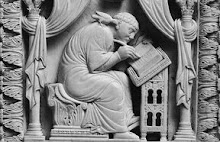
The books or music in which we thought the beauty was located will betray us if we trust to them: it was not in them, it only came through them, and what came through them was longing. These things—the beauty, the memory of our own past—are good images of what we really desire; but if they are mistaken for the thing itself, they turn into dumb idols, breaking the hearts of the worshipers. For they are not the thing itself; they are only the scent of a flower we have not found, the echo of a tune we have not heard, news form a country we have never yet visited.
—C.S. Lewis
Showing posts with label Faerie. Show all posts
Showing posts with label Faerie. Show all posts
Tuesday, November 3, 2009

Monday, November 2, 2009
Legends, Fairy Tales and Truth
“All too often the legends old men tell are closer to the truth than the facts young professors tell. The wildest fairy tales of the ancients are far more realistic than the scientific phantasms imagined by moderns.” —Hilaire Belloc
Wednesday, March 25, 2009
Children and Fairy Stories
It is accused of giving children a false impression of the world they live in. But I think no literature that children could read gives them less of a false impression. I think what profess to be realistic stories for children are far more likely to deceive them. I never expected the real world to be like the fairy tales. I think that I did expect school to be like the school stories. The fantasies did not deceive me: the school stories did. All stories in which children have adventures and successes which are possible, in the sense that they do not break the laws of nature, but almost infinitely improbable, are in more danger than the fairy tales of raising false expectations.
Almost the same answer serves for the popular charge of escapism, though here the question is not so simple.
Do fairy tales teach children to retreat into a world of wish-fulfillment— 'fantasy' in the technical psychological sense of the word— instead of facing the problems of the real world? Now it is here that the problem becomes subtle…The other longing, that for fairy land, is very different. In a sense a child does not long for fairy land as a boy longs to be the hero of the first eleven. Does anyone suppose that he really and prosaically longs for all the dangers and discomforts of a fairy tale?—really wants dragons in contemporary England? It is not so. It would be much truer to say that fairy land arouses a longing for he knows not what. It stirs and troubles him (to his life-long enrichment) with the dim sense of something beyond his reach and, far from dulling or emptying the actual world, gives it a new dimension of depth. He does not despise real woods because he has read of enchanted woods: the reading makes all real woods a little enchanted. This is a special kind of longing. The boy reading the school story of the type I have in mind desires success and is unhappy (once the book is over) because he can't get it: the boy reading the fairy tale desires and is happy in the very fact of desiring. For his mind has not been concentrated on himself, as it often is in the more realistic story.
…For, as I say, there are two kinds of longing. The one is an askesis, a spiritual exercise, and the other is a disease.
A far more serious attack on the fairy tale as children's literature comes from those who do not wish children to be frightened…Those who say that children must not be frightened may mean two things. They may mean (1) that we must not do anything likely to give the child those haunting, disabling, pathological fears against which ordinary courage is helpless: in fact, phobias. His mind must, if possible, be kept clear of things he can't bear to think of. Or they may mean (2) that we must try to keep out of his mind the knowledge that he is born into a world of death, violence, wounds, adventure, heroism and cowardice, good and evil. If they mean the first I agree with them: but not if they mean the second. The second would indeed be to give children a false impression and feed them on escapism in the bad sense. There is something ludicrous in the idea of so educating a generation which is born to the Ogpu and the atomic bomb. Since it is so likely that they will meet cruel enemies, let them at least have heard of brave knights and heroic courage. Otherwise you are making their destiny not brighter but darker. Nor do most of us find that violence and bloodshed, in a story, produce any haunting dread in the minds of children. As far as that goes, I side impenitently with the human race against the modern reformer. Let there be wicked kings and beheadings, battles and dungeons, giants and dragons, and let villains be soundly killed at the end of the book. Nothing will persuade me that this causes an ordinary child any kind or degree of fear beyond what it wants, and needs, to feel. For, of course, it wants to be a little frightened.
The other fears—the phobias—are a different matter. I do not believe one can control them by literary means…And I think it possible that by confining your child to blameless stories of child life in which nothing at all alarming ever happens, you would fail to banish the terrors, and would succeed in banishing all that can ennoble them or make them endurable. For in the fairy tales, side by side with the terrible figures, we find the immemorial comforters and protectors, the radiant ones; and the terrible figures are not merely terrible, but sublime. It would be nice if no little boy in bed, hearing, or thinking he hears, a sound, were ever at all frightened. But if he is going to be frightened, I think it better that he should think of giants and dragons than merely of burglars. And I think St George, or any bright champion in armor, is a better comfort than the idea of the police.
—C.S. Lewis, On Three Ways of Writing for Children
Almost the same answer serves for the popular charge of escapism, though here the question is not so simple.
Do fairy tales teach children to retreat into a world of wish-fulfillment— 'fantasy' in the technical psychological sense of the word— instead of facing the problems of the real world? Now it is here that the problem becomes subtle…The other longing, that for fairy land, is very different. In a sense a child does not long for fairy land as a boy longs to be the hero of the first eleven. Does anyone suppose that he really and prosaically longs for all the dangers and discomforts of a fairy tale?—really wants dragons in contemporary England? It is not so. It would be much truer to say that fairy land arouses a longing for he knows not what. It stirs and troubles him (to his life-long enrichment) with the dim sense of something beyond his reach and, far from dulling or emptying the actual world, gives it a new dimension of depth. He does not despise real woods because he has read of enchanted woods: the reading makes all real woods a little enchanted. This is a special kind of longing. The boy reading the school story of the type I have in mind desires success and is unhappy (once the book is over) because he can't get it: the boy reading the fairy tale desires and is happy in the very fact of desiring. For his mind has not been concentrated on himself, as it often is in the more realistic story.
…For, as I say, there are two kinds of longing. The one is an askesis, a spiritual exercise, and the other is a disease.
A far more serious attack on the fairy tale as children's literature comes from those who do not wish children to be frightened…Those who say that children must not be frightened may mean two things. They may mean (1) that we must not do anything likely to give the child those haunting, disabling, pathological fears against which ordinary courage is helpless: in fact, phobias. His mind must, if possible, be kept clear of things he can't bear to think of. Or they may mean (2) that we must try to keep out of his mind the knowledge that he is born into a world of death, violence, wounds, adventure, heroism and cowardice, good and evil. If they mean the first I agree with them: but not if they mean the second. The second would indeed be to give children a false impression and feed them on escapism in the bad sense. There is something ludicrous in the idea of so educating a generation which is born to the Ogpu and the atomic bomb. Since it is so likely that they will meet cruel enemies, let them at least have heard of brave knights and heroic courage. Otherwise you are making their destiny not brighter but darker. Nor do most of us find that violence and bloodshed, in a story, produce any haunting dread in the minds of children. As far as that goes, I side impenitently with the human race against the modern reformer. Let there be wicked kings and beheadings, battles and dungeons, giants and dragons, and let villains be soundly killed at the end of the book. Nothing will persuade me that this causes an ordinary child any kind or degree of fear beyond what it wants, and needs, to feel. For, of course, it wants to be a little frightened.
The other fears—the phobias—are a different matter. I do not believe one can control them by literary means…And I think it possible that by confining your child to blameless stories of child life in which nothing at all alarming ever happens, you would fail to banish the terrors, and would succeed in banishing all that can ennoble them or make them endurable. For in the fairy tales, side by side with the terrible figures, we find the immemorial comforters and protectors, the radiant ones; and the terrible figures are not merely terrible, but sublime. It would be nice if no little boy in bed, hearing, or thinking he hears, a sound, were ever at all frightened. But if he is going to be frightened, I think it better that he should think of giants and dragons than merely of burglars. And I think St George, or any bright champion in armor, is a better comfort than the idea of the police.
—C.S. Lewis, On Three Ways of Writing for Children
Monday, February 9, 2009
From "The Sins of Prince Saradine" by Chesterton
They had moored their boat one night under a bank veiled in high grasses and short pollarded trees. Sleep, after heavy sculling, had come to them early, and by a corresponding accident they awoke before it was light. To speak more strictly, they awoke before it was daylight; for a large lemon moon was only just setting in the forest of high grass above their heads, and the sky was of a vivid violet-blue, nocturnal but bright. Both men had simultaneously a reminiscence of childhood, of the elfin and adventurous time when tall weeds close over us like woods. Standing up thus against the large low moon, the daisies really seemed to be giant daisies, the dandelions to be giant dandelions. Somehow it reminded them of the dado of a nursery wall-paper. The drop of the river-bed sufficed to sink them under the roots of all shrubs and flowers and make them gaze upwards at the grass. "By Jove!" said Flambeau, "it's like being in fairyland."
Father Brown sat bolt upright in the boat and crossed himself. His movement was so abrupt that his friend asked him, with a mild stare, what was the matter.
"The people who wrote the mediaeval ballads," answered the priest, "knew more about fairies than you do. It isn't only nice things that happen in fairyland."
"Oh, bosh!" said Flambeau. "Only nice things could happen under such an innocent moon. I am for pushing on now and seeing what does really come. We may die and rot before we ever see again such a moon or such a mood."
"All right," said Father Brown. "I never said it was always wrong to enter fairyland. I only said it was always dangerous."
Father Brown sat bolt upright in the boat and crossed himself. His movement was so abrupt that his friend asked him, with a mild stare, what was the matter.
"The people who wrote the mediaeval ballads," answered the priest, "knew more about fairies than you do. It isn't only nice things that happen in fairyland."
"Oh, bosh!" said Flambeau. "Only nice things could happen under such an innocent moon. I am for pushing on now and seeing what does really come. We may die and rot before we ever see again such a moon or such a mood."
"All right," said Father Brown. "I never said it was always wrong to enter fairyland. I only said it was always dangerous."
Tuesday, February 3, 2009
Elfin Coincidence
"In short, there is in life an element of elfin coincidence which people reckoning on the prosaic may perpetually miss."
—G.K. Chesterton, “The Blue Cross”
—G.K. Chesterton, “The Blue Cross”
Friday, January 30, 2009
Children and Dragons
Fairy tales do not tell children the dragons exist. Children already know that dragons exist. Fairy tales tell children the dragons can be killed.
--G.K. Chesterton
--G.K. Chesterton
Subscribe to:
Posts (Atom)